Indoor rowing is one of the rare home workouts that really does it all in one session. You’re pulling with your shoulders and back, then driving through your quads, hamstrings, and glutes every single stroke. That’s exactly why so many people are searching for the Best Magnetic Rowing Machines in the UK right now — it’s efficient, it works, and once you settle into a rhythm it becomes surprisingly satisfying. The only problem is the UK market is packed with “magnetic” rowers that look almost identical online, but feel totally different once you actually get on them.
For this guide, I tested these magnetic indoor rowers the way most people use them at home — both steady rows and interval workouts — and I’ve backed that up with real owner feedback to highlight the models that hold up day after day. Magnetic resistance is usually the best option for home because it’s typically smooth, quiet, and low maintenance, but the best machines also get the basics right: a solid resistance range, comfort, stability, a sensible footprint (and easy storage), plus a console that’s actually useful. Below are my four picks for the best magnetic resistance rowing machines, including the one I’d call the best magnetic home rower overall — and what to choose if you want the top magnetic resistance rowing machines without paying extra for features you won’t use.
Table of Contents
Quick Comparison: Best Magnetic Rowing Machines in the UK (4 I Tested)
For this roundup of the Best Magnetic Rowing Machines in the UK, I didn’t just skim the spec sheets — I actually tested these magnetic indoor rowers at home the way most of us use them: steady cardio rows and interval sessions, in real rooms where noise, footprint, and storage matter as much as resistance. I spent enough time on each machine to get past the “new toy” phase (roughly a week up to three weeks, depending on the model) and focused on the stuff that genuinely makes or breaks a home rower: how smooth the stroke feels, how stable it is, whether the resistance range is actually usable, seat and foot comfort, and how easy it is to move or store without it becoming a daily annoyance. And because magnetic resistance is usually the best fit for home rowing — quiet, smooth, and low maintenance — I paid extra attention to how each one behaves in a flat, then cross-checked my experience against repeated owner patterns (reliability, app issues, common frustrations). Quick transparency: some machines were provided for testing and others I bought myself, but I wasn’t paid to write this roundup — the picks below are based on real use.
| NordicTrack RW900 | NordicTrack RW300 | MERACH Q1S Pro Series | YPOO RM910-YF | |
|---|---|---|---|---|
| Best for | Premium coached rowing + big screen consistency | NordicTrack value for normal UK rooms | Best compact budget value (quiet, light) | Cheapest + smallest storage (fold-away) |
| Resistance | Motorized magnetic, 26 levels | Motorized magnetic, 26 levels | Motorized magnetic, 16 levels | Manual magnetic, 16 levels |
| Auto resistance | Yes | Yes | Yes | No |
| Noise | Very quiet (slightly louder high levels) | Quiet and smooth at home | Almost silent (flat-friendly) | Very quiet (flat-friendly) |
| Applications | iFIT | iFIT | Merach & Kinomap | N/A |
| Screen setup | 24″ HD pivot screen | 5″ LCD console | 3″ LED console | 3″ Basic LCD |
| Tablet holder | No | Yes | Yes | Yes |
| Space & storage | Huge. Not foldable. Upright storage possible | Huge. Not foldable. Upright storage possible | Compact. Light and upright storage possible | Ultra-compact. Folds + stores upright |
| Max user (spec) | 136 kg / up to 195 cm | 136 kg / up to 195 cm | 158 kg / up to 185 cm | 158 kg / up to 185 cm |
| Watch-outs | iFIT paywall + no handle +/- buttons; takes over rooms | Manual/basic without iFIT; Strava/Garmin syncing can be messy | Not ideal for tall/serious rowers; seat can be hard (cushion helps) | Low seat isn’t knee-friendly; folding can feel stiff/awkward to handle |
NordicTrack RW900 Review (24” iFIT Magnetic Rower)


If you’re hunting for the Best Magnetic Rowing Machines in the UK and you live in a flat (or you just don’t want to annoy everyone around you), the NordicTrack RW900 is genuinely one of the quietest magnetic indoor rowers I’ve used. I tested it for a week over a few sessions, mixing steady rows and longer interval workouts, and the noise stayed very low — it only crept up a bit when I pushed the resistance higher. A big reason for that is the belt drive: it keeps the ride quiet and pretty low-maintenance compared with chain-driven rowers. Mechanically, the stroke felt very smooth, and I actually liked that the rail has a slight forward incline. It made the position feel a touch more stable and comfortable than perfectly flat rails, and I had no slipping, no soreness, and no “seat drama” during 20–40 minute sessions (I’m 5’5″ / 75kg). The foot setup is another win too — the footplates feel secure, the straps are wide and comfy (no hot spots), and adjustments were quick.
Where the RW900 gets a bit complicated is everything around the screen and subscription. The 24″ pivoting HD touchscreen looks fantastic and rotates smoothly for off-rower workouts, but here’s the blunt truth: if you don’t pay for iFIT, the monitor feels pointlessly restricted. Netflix and Spotify work nicely, but only through iFIT, which I honestly think is a bit of a joke for a premium machine. That said, iFIT is the real “unlock” here — the outdoor-filmed sessions in gorgeous locations are where it shines, and the screen doubles as a hub for strength training, yoga, and stretching off the rower. You can also build your own workouts (time/distance/calories + custom intervals), and there are roughly a dozen onboard sessions if you just want something preset. iFIT’s Google Maps/Street View routes are… kind of weird because you’re “rowing” along roads, but it’s also genuinely unique once you try it.
My favourite iFIT feature on this rower is SmartAdjust — mostly because NordicTrack didn’t add resistance buttons on the handles. Reaching forward to tap the screen mid-row is annoying, and SmartAdjust makes that mostly disappear. Still, it’s hard not to ask: why no +/- buttons on the grips, or even basic voice control like “increase 5 levels”? On a “high-tech” rower, that omission feels lazy. Also worth knowing: my 24″ model didn’t have a cooling fan (the 22″ version does), and there’s no proper bottle/phone holder, so you’ll want a small table nearby. One more thing I did rate: the audio setup. The speakers are loud and clear, and you can separately control trainer voice vs app audio vs master volume (handy when you’re watching Netflix).
Space is the other big reality check. This thing is long, not foldable, and in a normal UK home it can feel like it’s permanently in the way unless you’ve got a dedicated gym area. Measure your space first and plan for a bit of clearance behind the rail — it’s not the sort of rower you casually tuck away between sessions. I’m not exaggerating: in my flat it was annoying enough that if I’d kept it, my wife would’ve wanted the rower gone before I finished my second week. It does have transport wheels and it’s not hard to move, but you need to be careful — that big screen is exactly the sort of thing you’ll smack into a doorway or corner if you’re rushing. And yes, it can store upright, but I don’t recommend doing that casually. It didn’t feel safe to me, it shakes, and I’d genuinely worry about stressing the screen/cables over time. If you’re planning to store it upright, I’d only do it with the wall-mount accessory so it’s properly secured.
Resistance-wise, you get 26 magnetic levels, and in my sessions they felt different enough to use properly — just don’t expect “spin bike” heaviness. Rowers aren’t built for that kind of max-force grinding (you’re pulling with your arms and back, not stomping down with bodyweight). For what most people want at home — steady cardio and longer intervals — the RW900 felt more than enough. You feel it after 20 minutes, not 20 seconds, which is exactly how rowing should be. If you’re chasing that competition-style “punishing” feel, you’ll want an air rower instead.
Quick specs
- Dimensions: 203.5 L x 55.4 W x 133.9 H cm
- Rower weight: 71 kg
- Max user weight: 136 kg
- Display: 24″ HD pivoting touchscreen
- Resistance: Magnetic, 26 levels
- Assembly: ~30 minutes, straightforward
- Audio/Extras: USB-C charging, 2 speakers, Bluetooth headphone connectivity
- Warranty: 12 months Parts & Labour warranty included. Upon warranty registration within 28 days of purchase – 5-Year Frame Warranty and 2-Year Parts & Labour Warranty.
What I liked
- One of the quietest best magnetic resistance rowing machines I’ve tested (great for flats)
- Very smooth stroke and stable rail feel (that slight forward incline works)
- 24″ pivoting screen is brilliant for cross-training if you’re using iFIT
- SmartAdjust genuinely helps (especially since there are no handle buttons)
- Footplates/straps are secure, comfy, and easy to adjust
What I didn’t like
- The screen is basically locked down unless you subscribe to iFIT — annoying for the price
- No resistance buttons on the handles (and no voice control) is a big usability miss
- Huge footprint, not foldable, and awkward in a normal UK living space
- Upright storage felt shaky and not practical without the wall mount
- Not the best choice for advanced rowers who want a more performance-focused rowing feel
My final verdict
If you want a quiet, smooth, high-tech magnetic indoor rower with coached workouts — and you’ve got the space for it — the RW900 deserves a spot among the top magnetic resistance rowing machines in the UK. It’s especially good for people who stay consistent when they’ve got a big screen, structured classes, and SmartAdjust handling the resistance changes.
If you hate subscriptions, you’re tight on space, or you want the most performance-focused rowing feel, you’ll probably be happier with something simpler (or a different resistance style entirely).
NordicTrack RW300 Review (Compact iFIT Magnetic Rower)


I’ve owned the NordicTrack RW300 for about two weeks, and that’s been long enough to see what it’s really like as a best magnetic home rower in a normal UK setup — especially if you’re trying to fit one of the Best Magnetic Rowing Machines in the UK into a smaller room without it taking over your life.
The main reason I went for the RW300 as one of the top magnetic rowers is simple: it’s far more realistic for UK homes than long “purist” rowers like the Concept2 or even the RW900. Those machines can be brilliant, but they’re also long, and in my case they were just too much for anyone without a dedicated home gym. The RW300 fits comfortably in my small room — for context, it sits fine in a 2.7m x 2m box room — which is exactly the kind of real-life constraint most people are dealing with.
Build-wise, it feels like classic NordicTrack: solid, durable, and properly “premium” in how it sits on the floor. Owner reviews back that up too — people mention quick delivery, a sturdy feel, “very hi-tech,” and that it’s a massive upgrade over older budget rowers. Mechanically, the rowing feel is smooth with steady resistance, which is exactly what most people want from magnetic indoor rowers for home cardio. And because it uses Silent Magnetic Resistance (SMR™) plus an inertia-enhanced flywheel, it has that controlled, consistent feel that works brilliantly for steady sessions. I just wish they put a set of buttons on the handle to change resistance when I want.
The biggest criticism you’ll see online is that it’s not the most “traditional” rowing feel compared to a Concept2 or other air rowers, and I agree it’s not trying to be that benchmark machine. But if you’re not chasing a purist experience and you just want a reliable and quiet indoor rower for calorie burn and cardio fitness, it absolutely does the job — and iFIT is what turns it from “row at a wall” into something you’ll actually stick with.
On the tech side, the RW300 is the smarter buy than it looks. Instead of paying for a giant built-in screen like the RW900, you get a 5″ LCD display + device shelf and you connect your own phone/tablet to iFIT. The app genuinely makes rowing “more fun,” because it adds structure and stops sessions feeling repetitive. And if you want a bigger view, you can use your own device and cast to a TV, which gets you a very similar guided-workout vibe without paying RW900 money. You also get small but useful touches like a USB-C charging port, two speakers, and Bluetooth headphone connectivity.
That said, the subscription side is still the “real talk” part. iFIT can feel pricey, and if you don’t plan to use it, the RW300 becomes less compelling (you’re basically rowing in manual mode with a simpler experience). Also, while iFIT claims syncing with Strava/Garmin/Apple Health, some owners have reported frustrations — Garmin behaving more like HR sharing than full integration, and Strava syncing once and then not again. So yes, it can sync, but I wouldn’t treat that as flawless for everyone.
If you want to use the RW300 with third-party rowing apps or tracking platforms, it’s worth trying the QZ app as a bridge. From what I’ve seen, QZ can pull data from Bluetooth-enabled machines and then pass it on to other major apps. I haven’t personally tested it with the RW300 yet, but if you prefer non-iFIT ecosystems, I’d still give QZ a shot.
I read someone said the foot setup came loose and didn’t hold their feet tightly (they even used tape). I can’t relate to that on build quality — the machine feels very strongly put together — but it’s still something I’d check early on during your first few sessions because foot security affects everything.
Quick specs
- Dimensions: 206.5 L x 63 W x 111.8 H cm
- Rower weight: 58.1 kg
- Max user weight: 136 kg
- Display: 5″ LCD + device shelf
- Resistance: Magnetic, 26 levels
- Assembly: ~30 minutes, straightforward
- Audio/Extras: USB-C charging, 2 speakers, Bluetooth headphone connectivity
- Warranty: 12 months Parts & Labour warranty included. Upon warranty registration within 28 days of purchase – 5-Year Frame Warranty and 2-Year Parts & Labour Warranty.
What I liked
- Fits real UK spaces better than long air rowers (the RW300 length is manageable at 206.5 cm)
- Solid, durable, quality feel — it genuinely feels like proper kit, not a flimsy budget rower
- Smooth stroke + steady resistance (great for consistent cardio sessions)
- The “bring your own screen” setup is smart: device shelf + iFIT without paying RW900 money — and you can cast to a TV
- Useful extras: USB-C charging, Bluetooth headphones, and the built-in speakers are genuinely handy
- Sturdy, smooth, and an upgrade from older rowers
What I didn’t like
- Without iFIT, it becomes a much more basic rowing experience — don’t buy it if you refuse subscriptions
- iFIT can feel expensive for solo users, even if it’s still cheaper than a gym membership
- Strava/Garmin syncing isn’t always reliable in real life
- Not foldable to save space and storing upright is not very safe and stable
My final verdict
If you want one of the top magnetic resistance rowing machines that feels solid, rows smoothly, and actually fits typical UK homes, the RW300 is a smart choice. It’s not a purist “Concept2 replacement,” but as a best magnetic home rower for cardio fitness — especially if iFIT keeps you consistent — it nails the job without forcing you to pay for an expensive built-in screen.
If you hate subscriptions, want guaranteed perfect Strava/Garmin syncing, or you’re chasing the most authentic competition-style rowing feel, you’ll likely be happier with a different style of rower — even if it takes up more space.
MERACH Q1S Pro Review (Budget Self-Powered Magnetic Rower)


If you’re putting together a list of the Best Magnetic Rowing Machines in the UK and you want something that’s genuinely quiet, compact, and great value, the MERACH Q1S Pro surprised me in a good way. I used it for about three weeks and logged nearly 10 sessions, mostly because it’s one of those magnetic indoor rowers that’s everywhere right now — so I wanted to see if the hype is real after spending time on NordicTrack machines.
My headline take: it’s much lighter and more compact than the RW300/RW900, it’s almost silent in a flat, and it’s a brilliant “get on, row, burn a couple hundred calories, get off” kind of machine. If you’re expecting to train like you would on a Concept2 (or you’re trying to chase that punishing, competition-style rowing feel), this isn’t that. But as a best magnetic home rower for everyday cardio and consistency, it’s an easy recommendation at its price.
For my height (around 5.5), the stroke length felt spot on. I could get forward comfortably, row naturally, and still keep the stroke smooth without feeling cramped. That said, I’ll be blunt: I don’t think it’s ideal for people taller than 6′ or more serious rowers. The machine is compact, and once you get past a certain height, that shorter geometry can start to mess with the stroke. If you’re around average height or shorter, it’s a much safer bet.
It’s also lower to the ground than the NordicTrack rowers, which changes the “feel” of getting on and rowing. You’ll naturally bend further than you do on the RW300/RW900, and if you have knee or mobility issues, that low height is something to think about.
This thing is very quiet — almost silent in my flat. No “fan roar,” no chain noise, and I could easily row while someone’s watching TV. Stability was surprisingly good too: no wobble at all in my sessions. It’s not as “tank-like” as the NordicTracks, but it still felt stable where it matters.
Even at lower resistance, it’s enough to get a proper cardio session in. I’d describe it as a machine that’s built for fitness, calorie burn, and consistency, not a machine you’re going to “out-row” like a Concept2. If your goal is steady rows and intervals that make you sweat over 20–30 minutes, it does the job. If your goal is maximum-force, back-dominant power training, you’ll want something more performance-focused.
The seat is my biggest comfort knock. It’s a bit hard and not the most comfortable for longer sessions — but this was a totally fixable issue for me. I used a basic seat cushion and it completely solved the problem. The only trick is: don’t buy a cushion that’s wider than the seat by a lot, or it’ll feel awkward and slide around. Anything reasonably sized works.
I generally prefer fixed pedals, and that’s still true here. This model has footplates that can swivel/feel less locked-in than premium rowers, and while that kind of thing can bother some people, it didn’t affect my rowing in practice at my height and pace. The low-cost nature shows up most in small details like this — not deal-breaking, but worth knowing.
One of my favourite things about the Q1S Pro is that it’s self-powered. No hunting for sockets, no trailing cables, and it’s easy to shift around because it’s so light compared to the NordicTrack machines. Since I rotate products in and out for reviews (and sometimes sell/return machines to make space), that matters a lot. In day-to-day home use, it’s just convenient.
Quick specs
- Dimensions: 165 L x 48 W x 63 H cm
- Rower weight: 20 kg
- Max user weight: 158 kg
- Display: Basic LED console
- Resistance: Electronic magnetic 16 levels
- Assembly: ~10–15 minutes
- Audio/Extras: Self-generated power (no plug), Bluetooth + app support, phone/tablet holder, double rail
- Warranty: 1 year warranty on all parts and frame
What I liked
- Almost silent in a flat — one of the quietest magnetic resistance rowing machines I’ve used
- Compact and lightweight compared to the RW300/RW900 (much easier to move around)
- Great fit for average and shorter riders — at 5’5″, the stroke length felt natural
- No wobble in my sessions; stable enough for real cardio work
- Self-powered (no power outlet needed) which makes it far easier to place anywhere
- Excellent value for money — one of the best-value magnetic indoor rowers I tested
What I didn’t like
- Not ideal for taller or more serious rowers who want a long, “purist” stroke
- Lower seat height means you bend more than on NordicTrack rowers (less friendly if you have knee/mobility issues)
- Seat is hard/uncomfortable out of the box (but a simple cushion fixes it)
- Not foldable to save space when the rower is not being used
My final verdict
If your goal is to buy one of the best magnetic resistance rowing machines for the UK that’s quiet, compact, and affordable, the MERACH Q1S Pro is a fantastic starting point. It’s the kind of best magnetic home rower that makes it easy to row consistently, burn a few hundred calories a day, and keep your cardio habit going — without needing a dedicated gym room.
If you’re taller, you want a longer stroke, or you’re chasing a more performance-focused feel like a Concept2 (or even the stronger, more premium NordicTrack experience), you’ll outgrow it — and you should spend more upfront on a bigger, more “serious” machine.
YPOO RM910-YF Review (Foldable Magnetic Rower for Small Spaces)

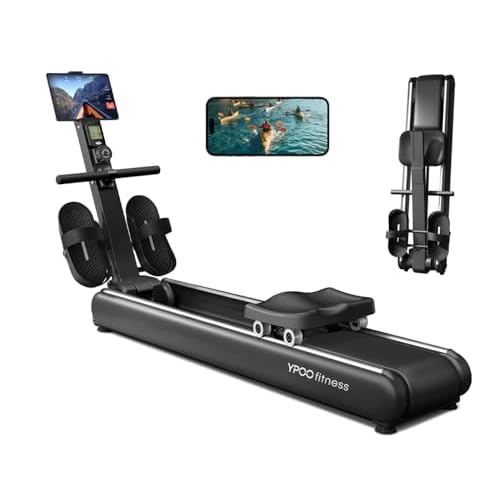
I picked up the YPOO RM910-YF because I wanted a genuinely budget-friendly option for this Best Magnetic Rowing Machines in the UK roundup — but more importantly, I wanted something super slim and compact that’s easy to live with in a normal home. And that’s where this rower really shines: when you fold it, it doesn’t turn into an awkward “L-shape” like a lot of foldable rowers, it folds into more of a straight, tidy “I” that’s much easier to tuck away. Add the front wheels and you can tip it up and roll it into a corner in seconds.
Let’s be clear: this isn’t a Concept2, Hydrow, or NordicTrack. It’s a simple, compact magnetic indoor rower that’s designed for steady home cardio, not performance rowing. In the week I had it, I got in solid steady sessions and it felt smooth, stable, and quiet — the kind of machine you can use in a flat while the TV is on without annoying anyone.
The rowing motion is fluid and the resistance is easy to control with a twist knob, which I love because it’s simple and less error-prone than some low cost fiddly electronic controls. You get 16 resistance levels, which is plenty for beginners and casual home workouts, and it’s easy to find a “daily cardio” setting.
But I’ll say it how it is: if you’re a mid-level or advanced rower, you may outgrow it. A lot of people end up living in the top end of the resistance range and still want more. This rower is best when your goal is consistent cardio and calorie burn, not chasing that competition-style “punishing” feel (for that, you’ll want an air or water rower).
This rower sits low to the floor, which is great for keeping it compact, but not great if you’ve got bad knees, arthritis, or mobility issues. Getting on and off can feel awkward, especially because the seat is on rollers and will move under you. If that’s you (or someone in your household), it’s worth thinking about a different style of rower — or even raising it on a sturdy platform.
Folding is the headline feature here, and it’s genuinely useful. The hinge can feel a bit stiff at first, and one annoying design thing is it doesn’t always “close” as perfectly as you’d want when stored upright. Also, despite being around 52 lbs / 21.8 kg, it can feel oddly awkward to handle because the body is rounded and there aren’t great handholds — so folding/unfolding is easiest if you take your time and don’t try to yank it around.
The onboard display does the basics: time, distance, calories, strokes/reps, strokes per minute, and that’s it. It’s readable, but it’s very “no-frills” — and use AA batteries but they’re a pain to change and that the counter behaviour is a bit annoying.
One more important point: the app/Bluetooth story is messy. Some people report tracking sessions fine and but I ouldn’t pair it at all (including with Kinomap), which is frustrating if you bought it specifically for app interaction. My advice: treat the YPOO as a manual-first rower with a basic monitor and a device holder — and consider any app pairing as a “bonus,” not the reason you buy it.
During the week I used it, I found it solid for the money, but I read those who had it for longer have had parts issues (for example, a track wheel breaking early). The upside is that when things do go wrong, the support experiences shared are mostly positive — replacements or parts sent quickly, and problems resolved without drama.
Quick specs
- Dimensions: 161.5 L x 41.4 W x 81.0 H cm
- Rower weight: 21.84 kg
- Max user weight: 158.8 kg
- Display: 3″ LCD monitor + device holder
- Resistance: Manual magnetic, 16 levels
- Assembly: ~10–15 minutes
- Audio/Extras: Foldable + transport wheels (stores upright)
- Warranty: 1 year warranty on all parts and frame
What I liked
- Extremely space-friendly — folds into a neat “I” shape and stores upright easily
- Quiet enough for flats (TV-on friendly)
- Smooth rowing motion with easy, simple resistance control (twist knob)
- Stable for a compact rower thanks to the dual-rail setup
- Very easy assembly (mine was about 10–15 minutes, and most of it comes pre-assembled)
- Great pick if you want a best magnetic home rower for steady daily cardio on a budget
What I didn’t like
- Low seat height makes it harder for older users or anyone with knee/joint issues
- Folding/moving can feel awkward because there aren’t good handholds (even though it’s not super heavy)
- Resistance can feel limited if you’re fitter/stronger (easy to outgrow)
- The monitor is basic and some versions have annoying battery quirks
- No Bluetooth on my unit and therefore no app connection.
My final verdict
If you want the cheapest, most compact option in this Best Magnetic Rowing Machines in the UK roundup — something you can row on quietly, fold away fast, and store without sacrificing your whole room — the YPOO RM910-YF earns its place. It’s a solid budget magnetic indoor rower for daily steady cardio, and it’s one of the easiest to live with when space is tight.
If you’re taller, you’ve got joint/mobility issues, you want guaranteed app integration, or you’re chasing the most demanding “athletic” rowing feel, you’ll likely be happier with one of the more premium top magnetic resistance rowing machines (or an air rower) even if they take up more space.
Buyer’s Guide: How to Choose the Best Magnetic Rowing Machine in the UK

Magnetic rowers are excellent for cardiovascular training at home. At a low impact on your joints, rowers provide a total body workout like no other. Rowing workouts combine endurance, coordination, agility, and strength and work over 80 percent of the body’s muscles at once. That said, it is important to choose the right machine for you, so you can achieve the optimal workout and benefits that rowing has to offer. So, now that we have reviewed the best magnetic rowing machines in the UK, this next guide is meant to help you narrow down the right one. Here are some factors to consider when shopping for indoor rowing machines with magnetic resistance.
User Height and Max Weight (Fit Matters More Than You Think)

First and foremost, you want to make sure your magnetic home rower can accommodate your size. Make sure the weight capacity is not an area of concern. You will also want to note the rower inseam length, which is how far the seat travels on the beam and will affect whether you can fully extend your legs while rowing. You will especially want to double-check this feature if you are over six feet tall.
Size, Footprint, and Storage (Foldable vs Upright Storage)

Unless you have a gym space that you are ready to dedicate a permanent rower space to, you will want to make sure your magnetic rower is foldable. Check each rower’s specifications and see how easy or difficult they are to break down if you plan to be moving them around a bit. All of the rowers on this guide fold up in some way, some smaller and more conveniently than others.
Budget and Value (Where Paying More Actually Matters)

The biggest “budget trap” I see with magnetic indoor rowers is people spending £200–£400 on a cheaper model, then trying to force it into a premium ecosystem like iFIT, Peloton, or Hydrow with workarounds; sometimes it kind of works, but it’s rarely smooth and you usually end up frustrated (or paying twice). My honest take is simple: if you already know you’re happy to pay £30–£40 per month for iFIT/Peloton/Hydrow-style training, it often makes more sense to spend more and buy a rower that’s built for that platform (or at least designed to integrate properly), because you’re paying for the structure, tracking, and the “it just works” experience
Seat, Handle, and Footplates (Comfort = Consistency)

You want your rower to be comfortable, no matter how long your distance. Check that the handlebars are non-slip and ergonomically designed, as some of the less expensive rowers might have straight hand grips that are not ideal for comfort or efficiency. Also, be sure that the seat is cushioned before buying a rowing machine for home.
Monitor and App Support (iFIT, Bluetooth, and Third-Party Tracking)

Last but not least, determine how important tracking your stats is to you. Also, if you prefer specific connectivity, whether USB or Bluetooth. The computer your rower comes with will also determine how many preset programs are available and what apps you can use it with. All of these magnetic rowers come with some type of console, so consider all the stats you will want to track, and do not opt for a rower with a basic console if you will end up wishing you had gone for the high precision touch screen monitor.
Conclusion: Which Magnetic Home Rower Should You Buy?
Magnetic rowers are the sweet spot for most UK homes because they’re quiet, smooth, and low-maintenance — no sloshing noise, no water treatment, and generally much easier to live with than water rowers (which are heavier and more of a “move it once and leave it” setup). The trade-off is that even the best magnetic resistance rowing machines usually won’t give you that punishing, competition-style, daily max-effort feel you get from a proper air rower (think Concept2-style) because air rowers scale harder the more force you put in. Also, magnetic rowers aren’t all equal: cheaper, ultra-compact models often top out sooner on resistance, even if they’re brilliant for quiet cardio.
- NordicTrack RW900 — best if you want the most “premium” magnetic experience with a 24″ screen + iFIT structure, you need it very quiet for a flat, and you’ve got the space (big watch-out: iFIT paywall and it’s physically huge).
- NordicTrack RW300 — best if you want a solid NordicTrack feel that fits more normal UK rooms, and you’re happy using your own phone/tablet for iFIT instead of paying RW900 money for a built-in screen (watch-out: without iFIT it’s much more basic, and syncing can be hit-and-miss).
- MERACH Q1S Pro — best if you want maximum value in a compact, light rower that’s easy to move around and doesn’t need a plug (self-powered), and your goal is steady cardio/longer intervals rather than hardcore rowing performance (watch-out: not ideal for taller or serious rowers, and the seat can feel firm without a cushion).
- YPOO RM910-YF — best if your #1 priority is space-saving and you want the easiest fold-away option you can stash daily (I folded it every day with no wobble), but be aware it had less resistance than the others, the seat was less comfortable, and in my testing the app/Bluetooth didn’t connect (my phone couldn’t find it to pair).
